When analyzing the Saturn return, there are some principles you can follow to understand the transit more holistically.
Some of them are:
- Sect of the natal chart
- Sign of the natal Saturn
- Retrograde or direct motion of the natal Saturn
- How many times the return is exact
- Another house (or houses) ruled by Saturn
- Challenging aspects that Saturn makes to other planets or angles
- What happened in the previous 7-year cycles of Saturn
In this text, I’ll explore Saturn’s challenging aspects to other planets or angles. But first, I’ll introduce the concept of aspects in astrology.
I use Stephen Arroyo’s book Chart Interpretation Handbook: Guidelines for Understanding the Essentials of the Birth Chart as a guide.
This is the table of contents:
- What Are Aspects in Astrology?
- How Many Aspects Exist in Astrology?
- Challenging Aspects in Astrology
- Harmonious Aspects in Astrology
- The Dance Between Challenging and Harmonious Aspects
- The 5 Ptolemaic Aspects of Hellenistic Astrology
- Are Exact Aspects More Powerful in a Natal Chart?
- Aspects Between Transpersonal Planets in the Natal Chart
- Journaling Prompts to Analyze the Aspects in Your Natal Chart
Let’s go!
What Are Aspects in Astrology?
Planets located in different signs represent basic impulses that seek expression and also the search for satisfaction.
Aspects reveal the actual state of energy flow and the effort needed to express a specific impulse or satisfy a particular need.
Therefore, the aspects in a birth chart represent the dynamic interactions between the various energies of life.
Aspects show the connections between the planets and the Ascendant, Midheaven, IC, or nodes, to mention just a few points in the natal chart.
They are measured within the 360 degrees of the birth chart circle. The zodiac has twelve signs occupying 30 degrees each, from degree 0 to degree 29. An aspect necessarily occurs within these confines.
An aspect does not indicate whether you will achieve or experience something specific, but it does indicate how much effort you will need to exert to be successful in the area of life involved.
From now on, I will only use the term “planets” in a general sense and for simplification but don’t forget that the angles of the chart, the Sun, the Moon, and the nodes also create aspects.
How Many Aspects Exist in Astrology?
There are MANY aspects in astrology. But you don’t need to use them all when you start analyzing your natal chart.
First, you need to focus on the five aspects Hellenistic astrology uses.
These aspects are known as Ptolemaic aspects because the mathematician, astronomer, and astrologer Ptolemy defined and employed them in the 1st Century AD.
The five Ptolemaic aspects are:
- Conjunction (0° of separation between the planets involved, even though it’s not strictly an aspect)
- Sextile (60° of separation)
- Square (90° of separation)
- Trine (120° of separation)
- Opposition (180° of separation)
These aspects can be divided into those that are more challenging and those that are more harmonious.
The conjunction can be seen as a “wildcard aspect” (my words, not Ptolemy’s) because it can be harmonious or challenging depending on the interacting planets.
Challenging Aspects in Astrology
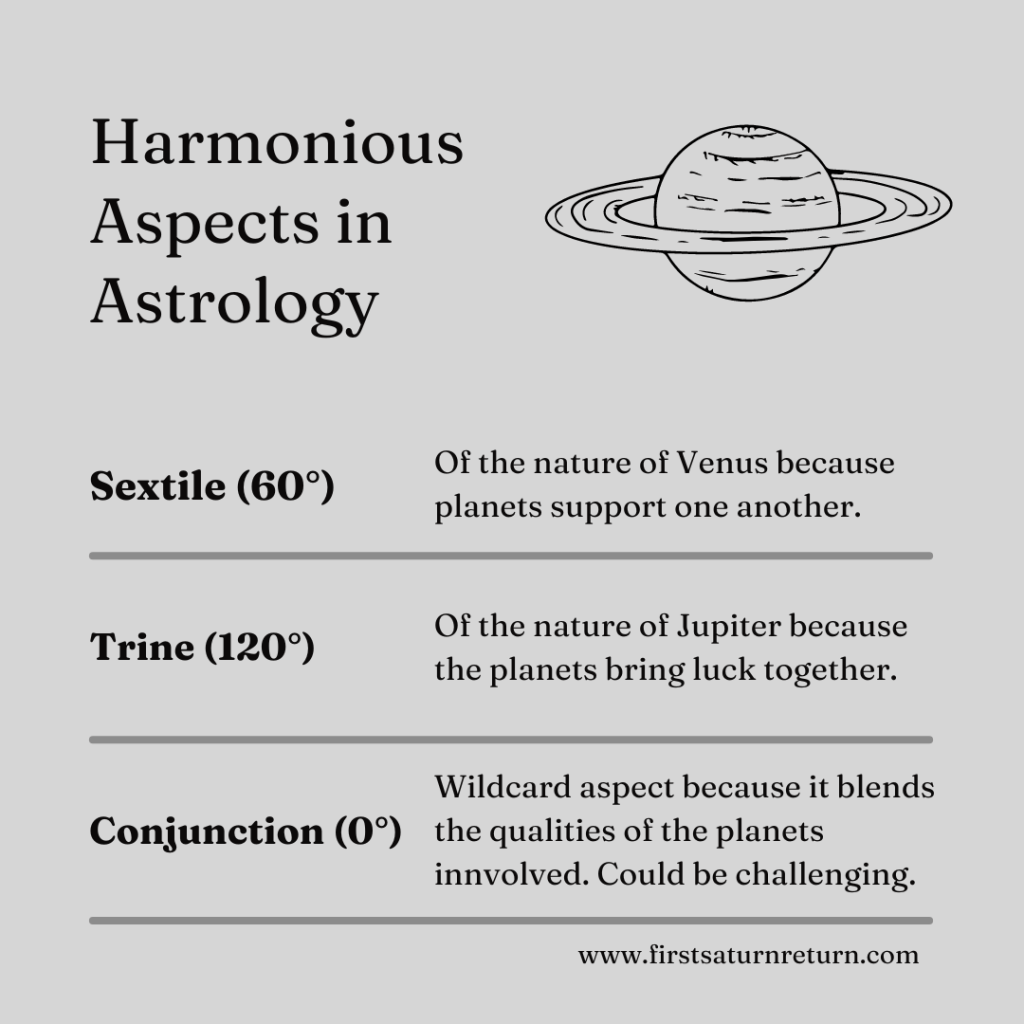
In astrology, the Ptolemaic aspects known as challenging, dynamic, or stimulating are:
- Square (90°)
- Opposition (180º)
- And sometimes the conjunction (0º), depending on the planets involved
These aspects indicate a certain internal tension. Generally, they prompt action in a defined way or expand awareness in the life areas governed by the involved planets.
Although terms like “disharmonious,” “difficult,” or “bad” are often used in traditional astrological literature to refer to these aspects, such terms can be derogatory.
It is possible that if you have “difficult” aspects in your birth chart, you can express these energies constructively through work, accepting responsibilities, and other challenges that allow you to transform the intensity of the tension into something more beneficial.
Challenging aspects indicate that the involved energies do not vibrate harmoniously. These energies tend to interfere with each other and thus create tension.
However, tension can lead you to take concrete steps to resolve what causes irritation or instability and alchemize into something different.
The proverbial phrase “when life gives you lemons, make lemonade” summarizes the attitude you need to implement towards the challenging aspects in your natal chart.
Harmonious Aspects in Astrology
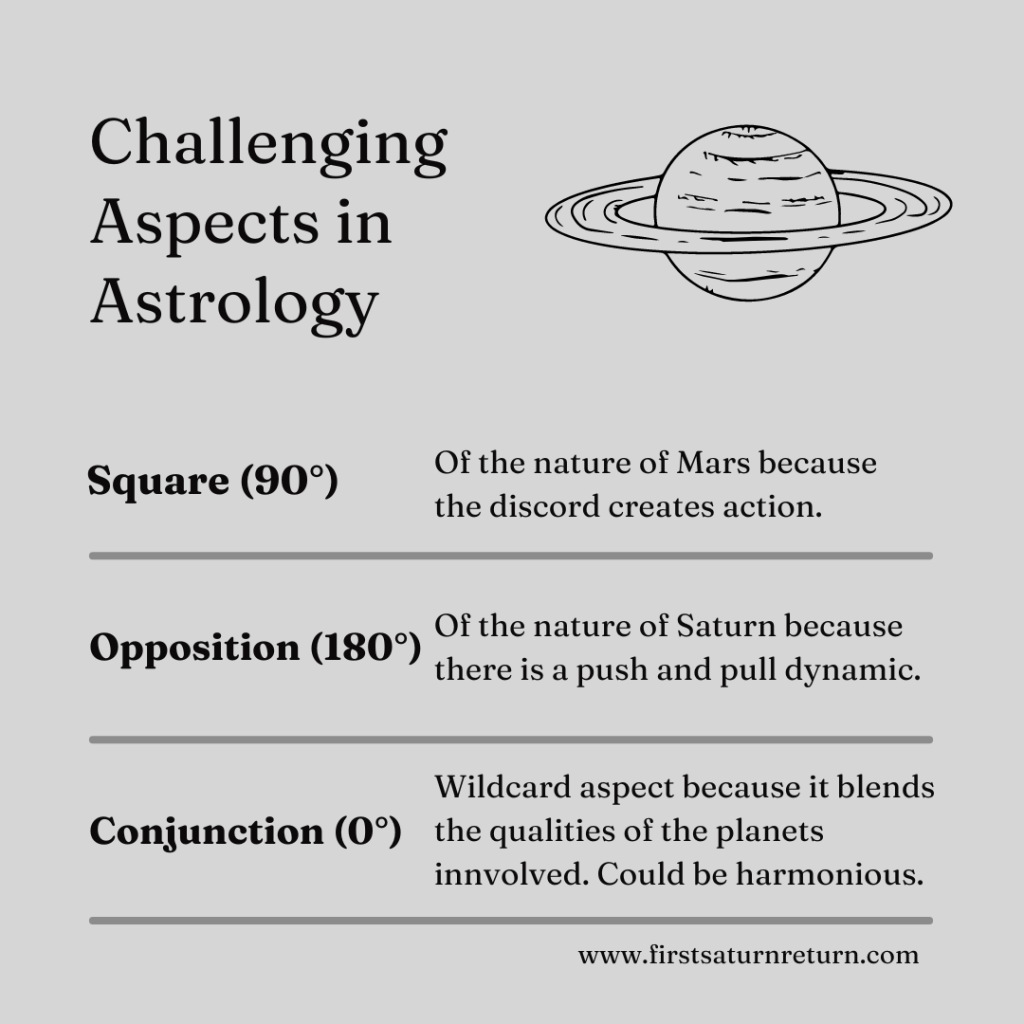
In astrology, the Ptolemaic aspects known as harmonious or fluid are:
- Sextile (60º)
- Trine (120º)
- And sometimes the conjunction (0º), depending on the planets involved
They relate to spontaneous abilities, talents, and forms of understanding and expression that you can use and develop easily and consistently.
These abilities are like personal assets, firm and steady, that you can rely on at any time.
Harmonious aspects show that the energies vibrate harmoniously and reinforce each other within your energy field.
Although you may prefer to direct your attention and energy towards the more challenging aspects, the harmonious aspects indicate the potential for developing extraordinary talents.
Harmonious aspects in the natal chart are like wanting to be a ballet dancer and having the perfect feet and physique to be successful in that field.
The Dance Between Challenging and Harmonious Aspects
Unlike challenging aspects, harmonious aspects indicate a way of being and a spontaneous harmony that is expressed comfortably.
On the other hand, challenging aspects point to the need for adjustments through direct action, effort, and the development of new channels of self-expression.
Whether challenging or harmonious, each aspect must be evaluated according to the nature of the planets, signs, and houses involved.
For example, trines can manifest problematic or debilitating situations, which contradicts the traditional notion that this aspect is always positive.
You may have the perfect feet and physique to be a ballet dancer, but if you are not interested in doing so or don’t train to improve your skills, you may never realize your full potential.
Similarly, challenging aspects can symbolize energy expressed with great concentration, power, and creativity, although they may also show conflicts and problems, sometimes simultaneously.
Someone with “bad” feet can become a professional dancer if they desire to do so and devote themselves relentlessly to achieving that goal, even if the odds are not in their favor.
You have to remember that there is always beauty in the struggle and struggle in the success, as J. Cole taught us.
The 5 Ptolemaic Aspects of Hellenistic Astrology
Even though I’ll mention these 5 Ptolemaic aspects of Hellenistic astrology, considering the conjunction as a “wildcard aspect” doesn’t come from this tradition. This is my own classification:
- Wildcard aspect: Conjunction (0º)
- Harmonious aspects: Sextile (60º) and trine (120º)
- Challenging aspects: Square (90°) and opposition (180°)
Let’s deconstruct each of them.
Wildcard Aspect
Conjunction (0º)
The conjunction indicates the intense fusion and interaction of two vital energies. The keywords to explain the conjunctions are action and self-projection.
The most potent conjunctions involve personal planets (Sun, Moon, Mercury, Venus, and Mars) and/or the Ascendant. These conjunctions consistently denote strong torrents of energy and individual expression (determined by the planet and sign involved), and dominant themes in our lives (depending on the house or houses where they occur).
In psychological astrology, planets must be within 10 degrees of each other to be considered in conjunction. In Hellenistic astrology, the critical criterion is that planets are in the same sign.
For example, in my chart, Saturn is at 3 degrees of Aquarius, and the Ascendant is at 20 degrees of Aquarius.
According to psychological astrology, they aren’t in conjunction, but according to Hellenistic astrology, they are.
Hellenistic astrology doesn’t consider aspects based on exact degrees but rather on signs. According to this astrological tradition, if two planets are in the same sign, they are in conjunction.
Astrologers Chris Brennan and Leisa Schaim explain that the Saturn return activates planets in the same sign as the natal Saturn, as they are considered to be in conjunction in Hellenistic astrology.
But this is not the only aspect that gets activated. I don’t want to get too ahead, so let’s focus on aspects in general and then delve into the Saturn return specifically.
Harmonious Aspects
Sextile (60º)
The sextile is an aspect that symbolizes openness to the new: new people, new ideas, new attitudes.
It represents the potential to establish new connections with people or ideas that, over time, can lead to the discovery of something new.
In Hellenistic astrology, which, as mentioned, bases aspects on signs rather than degrees, the sextile is formed between signs of harmonious elements: Earth and Water, Fire and Air. This means that the interacting energies are compatible.
The sextile shows an area where you can cultivate new levels of understanding and objectivity. It indicates spontaneous harmony and often a specific ability.
It’s associated with the planet Venus.
Trine (120º)
A trine represents a flow of energy through familiar channels of expression. There’s no need to build a new structure or make significant adjustments to harness this energy creatively.
The planets in a trine reveal dimensions of life and specific energies that are spontaneously integrated and flow harmoniously.
In Hellenistic astrology, trines are always formed between signs of the same element (Fire, Air, Earth, or Water), creating a foundation for energy harmony.
The trine shows a way of being rather than a way of doing.
However, you often take for granted the abilities and talents shown by the trine, and, as a result, you may need more encouragement to make the effort required to use the energy constructively.
It’s associated with the planet Jupiter.
Challenging Aspects
Square (90º)
The square shows where trapped energy needs to be released. This release must occur through a specific action that allows for constructing a new outlet.
In Hellenistic astrology, the square is formed by planets in signs of the same modality (Cardinal, Mutable, or Fixed) in disharmonious elements: Earth with Fire, Air with Water, Fire with Water, and Earth with Air.
Integrating these divergent energies requires great effort. Squares formed by the five personal planets represent significant life challenges.
The square shows you what you must confront. When you face what the squares in your chart symbolize, you may experience fear.
But the fear of challenges diminishes the energy available to confront directly the problems that corner you. When dealing with a square, it is best to face it head-on, like a warrior.
It’s associated with the planet Mars.
Opposition (180º)
The opposition indicates an overstimulation of energy concerning the themes symbolized by the planets involved in the aspect. This overstimulation manifests as an internal conflict between two opposite tendencies.
In Hellenistic astrology, the opposition involves planets in opposite signs (Aries-Libra; Taurus-Scorpio; Gemini-Sagittarius; Cancer-Capricorn; Leo-Aquarius; Virgo-Pisces) and harmonious elements (Fire and Air; Earth and Water).
Generally, oppositions are experienced most challengingly in the realm of relationships.
If you have oppositions in your chart, this could indicate an overwhelming lack of objectivity.
You may project certain traits of your personality onto others. As a result, it becomes difficult to distinguish what belongs to you and what belongs to the other person.
Having an opposition in the natal chart shows a constant tug-of-war between two divergent and sometimes contradictory tendencies.
Opposite signs are similar in many respects and complementary, but in other ways, as their name suggests, they are completely opposite.
It’s associated with the planet Saturn.
Are Exact Aspects More Powerful in a Natal Chart?
Astrologer Stephen Arroyo argues that the more exact an aspect is, the more intensely that energy will manifest in a person’s life, whether challenging or harmonious.
Over the years, he became convinced that exact aspects are more powerful and should be given careful attention when interpreting a chart.
He recommends focusing on the most exact aspects, those with an orb no greater than 5 degrees.
Related: What Is the Natal Chart? Astrology 101
In other words, in your chart, you should look for aspects where planets are within a maximum distance of 5 degrees to identify which ones will be most potent in your life.
As mentioned previously, this premise differs from the premise of Hellenistic astrology.
Instead, Hellenistic astrology considers aspects based on whole signs rather than exact degrees.
However, Arroyo’s perspective, which is aligned with the tendency of psychological astrology, is also intriguing and shouldn’t be disregarded.
I think it’s important to first focus on the overall story offered by your natal chart (meaning aspects based on whole signs, as proposed by Hellenistic astrology) and then analyze aspects more granularly, considering the exact degrees where each planet is located.
Start with the bigger picture and then focus on the details.
Aspects Between Transpersonal Planets in the Natal Chart
Aspects between the three transpersonal planets, considered in isolation from other aspects in the chart, are not a significant factor in interpretation.
Uranus, Neptune, and Pluto have transpersonal meanings that impact entire generations as they remain in the same sign for several years.
In the initial stages of interpretation, it doesn’t make sense to worry about a conjunction between Uranus and Neptune, for example, only to discover later that all people born during a specific period have the same aspect in their natal charts.
Therefore, when analyzing a chart, it’s crucial to distinguish primary traits from secondary ones and focus first on what’s most relevant.
The only exception is considering these aspects if the planets are within 5 degrees of each other, as taught by psychological astrology.
Journaling Prompts to Analyze the Aspects in Your Natal Chart
Grab your Saturn Return Diary and get to work:
1. With your natal chart handy, find all the conjunctions. First, focus on the idea of Hellenistic astrology, so write all the planets/angles that are in the same sign, no matter how far from one another. Write down the planets, angels, and nodes involved and the degree in which they are located. (NOTE: If you don’t know how to get your natal chart, check my instructions here.) You can write 12 lines in your diary and put the twelve signs of the zodiac, one in each line, and next to the sign’s name, the planets you have in said sign. If you only have one planet in a sign, no worries. Write it for now for the sake of clarity. This is the zodiac order: Aries / Taurus / Gemini / Cancer / Leo / Virgo / Libra / Scorpio / Sagittarius / Capricorn / Aquarius / Pisces. After writing everything down, mark with an asterisk (*) those signs where you have two or more planets.
2. Check the asterisks you have written in point 1. Now, check the degrees of the planets involved. Write all the planets placed within a 5-degree distance from one another. To count the degrees appropriately, you have to count the degree in which the planet is located, meaning if you have a planet at 12 degrees and another at 15 degrees, you have to count the 12 and the 15, too.
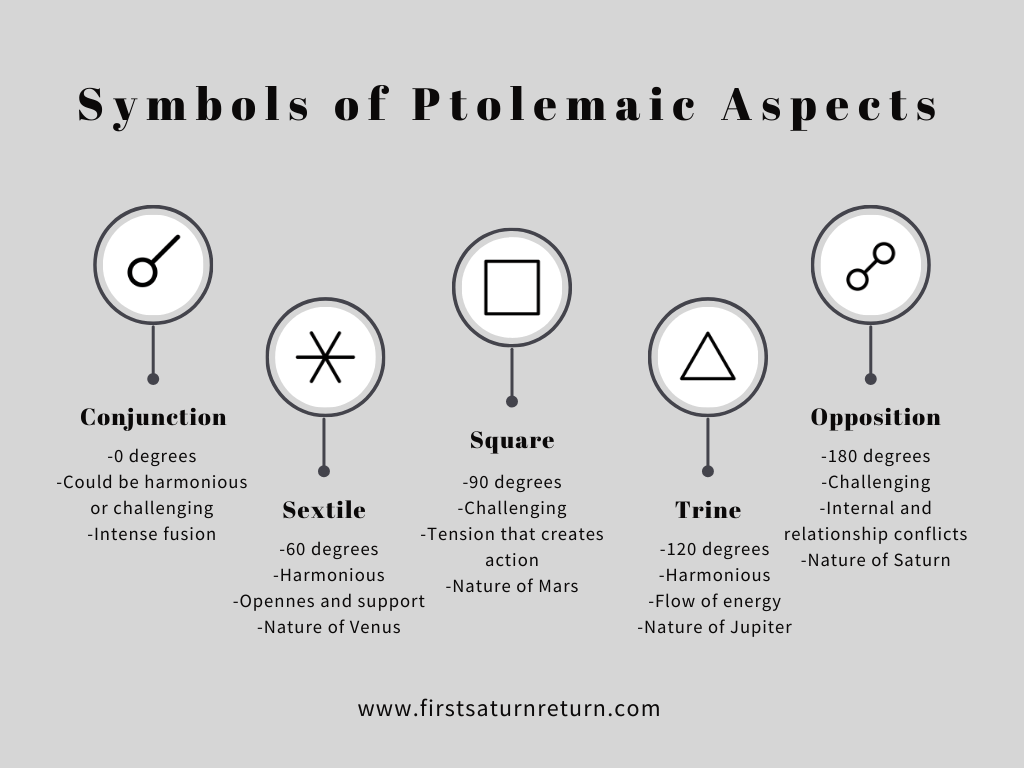
3. Find the other four Ptolemaic aspects and write them down in this order: oppositions, squares, sextiles, and trines. Write the degrees involved and include every aspect in this exercise, even if the planets are farther than 5 degrees from one another. Note: The nodes are always in opposition, so you don’t have to include this aspect in this exercise. To identify the different aspects, check the triangle (it looks like the side of a pyramid) under your circular birth chart obtained from astro.com. The aspects are expressed in symbols that you can decode using this graphic:
4. Do the same as you did in exercise 2: Find all aspects within a 5-degree distance. Mark them with an asterisk and then write them down for more clarification. Also, add to the list the closest conjunctions you identified in exercise 2.
5. Congratulations! You have just discovered the most powerful aspects of your natal chart. Next time, we’ll use what you have done in these exercises to analyze the impact of specific aspects in your Saturn return.
Let me know in the comments if you found this helpful. Until next time!



 First Saturn Return
Leave a reply to What Is the Saturn Return in Astrology? – First Saturn Return Cancel reply