When analyzing the Saturn return in astrology, there are some principles you can follow.
Some of them are:
- Sect of the natal chart
- Sign of the natal Saturn
- Retrograde or direct motion of the natal Saturn
- How many times the return is exact
- Another house (or houses) ruled by Saturn
- Challenging aspects that Saturn makes to other planets or angles
- What happened in the previous 7-year cycles of Saturn
I know it looks like a lot. But don’t worry. We’ll take it step by step.
In this post, I’ll just focus on the concept of sect and why it’s vital when checking your Saturn return.
This is the table of contents:
- What Is Sect in Astrology?
- Planets in Astrology and Their Sect
- Chris Brennan’s Comments About Sect
- My Own Experience With Sect During My First Saturn Return
- Journaling Questions About Sect and Your Saturn Return
Let’s start.
What Is Sect in Astrology?
“Sect” is a concept in traditional astrology born in Alexandria, Egypt, around the 2nd century B.C.
The concept of sect distinguishes between a diurnal birth chart and a nocturnal birth chart.
A diurnal birth chart is one where the Sun is located above the Ascendant-Descendant axis (in houses 7 to 12), while a nocturnal birth chart is one where the Sun is located below this axis (in houses 1 to 6).
Being born during the day or at night can give clues about your Saturn return. In short, those born during the day will have a more friendly Saturn return, while those born at night will have a more complex one.
The sect shows the qualitative differences in how planets act in a natal chart.
Related: Saturn’s Themes and Their Activation During The Saturn Return
In a diurnal chart, Saturn embodies its most constructive qualities, such as hard work, awareness of what needs to be done, and leadership.
On the other hand, in a nocturnal chart, this planet’s more challenging characteristics will emerge, such as losses, fears, or various types of restrictions.
Planets in Astrology and Their Sect
For the ancients, all traditional planets belonged to either the diurnal or nocturnal sect. Although the Moon and Sun are not planets, they are still included in this classification.
The diurnal planets are the Sun, Jupiter, and Saturn, while the nocturnal planets are the Moon, Venus, and Mars.
Mercury is versatile and can belong to either sect depending on other factors in the natal chart.
Each sect has three members:
- Luminary: Sun in a daytime chart; Moon in a nighttime chart.
- Benefic planet: Jupiter in a daytime chart; Venus in a nighttime chart.
- Malefic planet: Saturn in a daytime chart; Mars in a nighttime chart.
Benefic planets receive this characterization because they have the power to affirm or enhance certain spheres of existence.
On the other hand, the so-called “malefics” have the power to negate or harm certain areas of life.
Related: Astrology Basics: Your Birth Chart States of Consciousness
Saturn is considered a malefic planet in traditional astrology because it brings limitations and responsibilities.
However, it is more “comfortable” in a daytime chart than a nighttime chart and can yield better results for those born during the day.
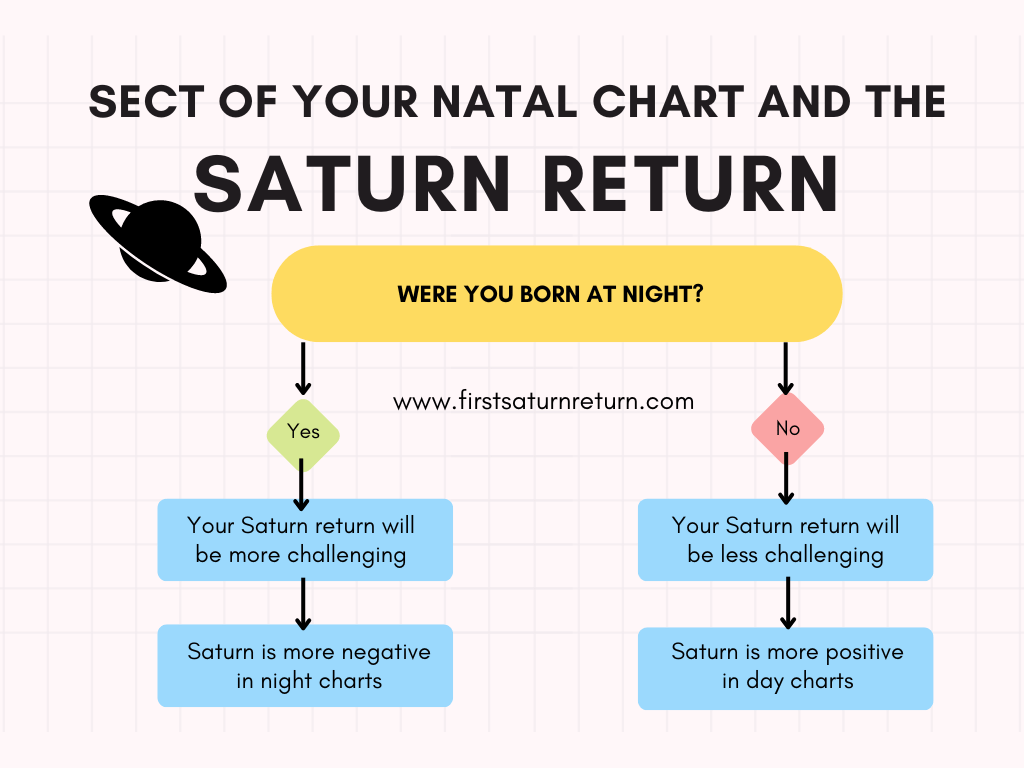
To sum it up, people born during the day experience their Saturn return and all the other transits of this planet more positively than those born at night.
On the contrary, people born at night may face challenges and adversities whenever Saturn activates their natal chart.
Here’s a visual aid that may be helpful:
Chris Brennan’s Comments About Sect
In episode 24 of The Astrology Podcast, Chris Brennan argues that the sect of a natal chart is the first consideration when analyzing the Saturn return.
He also states that psychological astrology does not consider the notion of sect. This is because the concept of sect was rediscovered in the late 20th and early 21st centuries thanks to translations that began to emerge from ancient astrology texts.
Brennan explains that since the concept of sect was unknown to modern astrology until relatively recently, it was not considered when analyzing Saturn returns in the 20th century.
The technical distinction between a diurnal birth chart and a nocturnal birth chart allows for a more precise description of the type of Saturn return (positive or negative, to simplify) that a person will experience.
For this reason, traditional astrologers working today want this fundamental notion to be used.
But the concept of sect “goes against,” so to speak, the view of psychological astrology, which holds that only your effort and willpower will determine the “success” of your Saturn return.
The sect of a chart indicates that a person born at night will have a more complicated transit, no matter how much willpower, effort, and hard work they exert.
Of course, willpower, effort, and hard work always help, but obstacles will appear nonetheless.
My Own Experience With Sect During My First Saturn Return
I was born at noon and have a diurnal chart. However, my return wasn’t as positive as I thought it would be.
But let’s take it bit by bit.
The first part was relatively easy.
As I mentioned in previous texts, I was prepared for the Saturn return, and the pandemic didn’t have a tremendous impact on my life. I was working from home, had just started a new romantic relationship, and I’m an introvert, so I enjoyed staying inside.
Related: Why I’m So Interested in the First Saturn Return (And You Should Too!)
The first part of Saturn’s visit to Aquarius in 2020 and 2021 was quite relaxing.
Until shit hit the fan.
My dad passed away due to COVID-19 complications in early 2022. EVERYTHING changed there.
Related: What Is the Saturn Return in Astrology?
The second part of my return was very tough.
In 2022, I had to deal with many legal and financial matters associated with my dad’s death. And all this while going through grief and supporting my mom in different capacities.
As a farewell to the return, at the end of February 2023, my grandmother (my dad’s mom), also passed away, right at the end of her third Saturn return.
In 2022 and the first part of 2023, I felt like I couldn’t stay afloat, like I was drowning. No matter how hard I tried to swim to the surface, I was always on the verge of drowning.
Today, I can say that my return was constructive despite all the pain and difficulties—or maybe it was constructive because of them.
It was a transformative period that showed me how strong I actually am, how capable I am of dealing with the unexpected, and how flexible I can be when the situation requires it.
The truth is, I had certain tools and some habits (like daily meditation practice) to be able to solve everything I had to and not die in the attempt.
Related: My Experiences with the Saturn Return: From Hobby to Business Back to Hobby
As an astrologer, I also had the opportunity to analyze the Saturn return of many diverse people.
And I also noticed difficulties in clients and friends born during the day.
With this, I mean that the concept of sect can be helpful as a first approach to analyzing the Saturn return, but don’t despair if you were born at night. Nor think everything will be perfect if you were born during the day.
The best attitude is to remember that what will happen will happen and that you can summon the strength necessary to navigate those challenges.
Journaling Questions About Sect and Your Saturn Return
Grab your Saturn Return Diary and write this down:
- Look at your birth chart. Identify the Sun. Is it above the horizon (in houses 7 to 12), or below the horizon (in houses 1 to 6)? If it’s above the horizon, you have a diurnal sect. If it’s below the horizon, you have a nocturnal sect. Write your sect down.
- If you were born at night, write 5 activities your Moon enjoys doing by house and sign.
- If you were born during the day, write 5 activities your Sun enjoys doing by house and sign.
- Write 10 strategies you would implement when things get tough. Check the text about regulating your nervous system for more ideas.
We’ll come back to these answers in the future. That’s it for now. Until next time!







 First Saturn Return
Leave a comment